If your power is back but your AC is not working, the most common causes are a tripped breaker, the system's built-in restart delay, a thermostat that lost its settings, or a capacitor damaged by the surge when the power returned. Start with the safe checks below before assuming the worst — many outage problems are simple. If the breaker keeps tripping or you smell burning, stop and call a professional.
Ocala and Marion County see plenty of short outages and flickers during storm season, and air conditioners are one of the most surge-sensitive appliances in the home. This guide walks through what happens to your AC during an outage, what you can safely check yourself, and what needs a technician.
Why a Power Outage Can Stop Your AC
An air conditioner usually does not fail during the outage itself — it fails when the power comes back. The returning surge, and the low-voltage brownout flickers that often come with storms, strain the parts that start your compressor and fan motors.
- Restart delay: Many systems wait several minutes after power returns before starting, to protect the compressor. The unit can look completely dead when it is only waiting.
- Tripped breaker or blown fuse: The surge when power is restored can trip the AC breaker in your panel or the fuse in the outdoor disconnect.
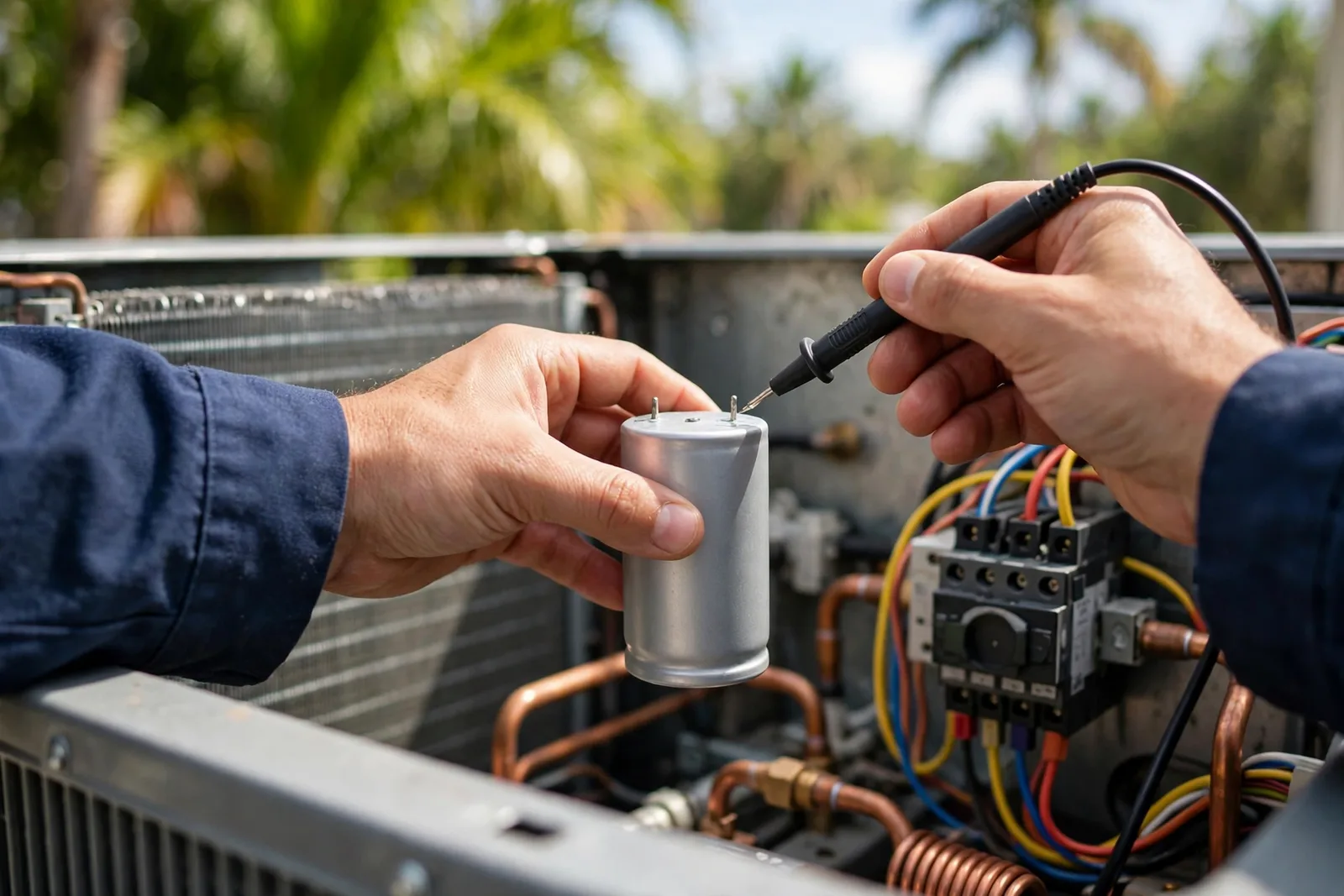
- Failed capacitor: The capacitor gives the compressor and fan motors their starting push. A surge can finish off a weak one — the classic “hums but won't start” failure.
- Thermostat reset: Some thermostats lose their settings or schedule when power drops, so the system never gets the call to cool.
- Control board damage: Less common, but a strong surge can damage the board that runs the system.
Safe Checks to Try First
Work through these in order. They take a few minutes and none of them require opening the unit.
- Give it a few minutes. Wait at least 5 minutes after the power is stable — the restart delay has to run out before anything happens.
- Check the thermostat. Make sure the display is on, it is set to COOL, and the temperature is set below the current room temperature. If the screen is blank, it may need batteries, or the system has no power at all.
- Check your breaker panel. Find the AC breakers. If one is tripped, switch it fully off, then back on — once. If it trips again right away, leave it off and call a professional.
- Look at the outdoor unit. Storms drop palm fronds and branches on condensers all over Ocala. Clear loose debris from around the unit so it can breathe — and never reach inside the fan guard.
- Check the air filter. If the indoor fan runs but airflow feels weak, a clogged filter may be choking the system. Replace it if it is dirty.
If the system starts and cools after these checks, let it run and keep an eye on it for the next hour. If it short-cycles, struggles, or warms up again, something was damaged — see the warning signs below.
Stop and Call a Professional If You Notice Any of These
- The breaker trips again as soon as you reset it
- A burning or electrical smell near the indoor or outdoor unit, or scorch marks at the disconnect
- The outdoor unit hums, buzzes, or clicks but never starts
- The fan spins but the air from the vents is still warm an hour after power returned
- Ice building up on the copper lines or the indoor coil
These point to electrical damage — a failed capacitor, contactor, board, or a compressor problem — and repeated restarts can make the repair bigger. This is exactly what our emergency AC repair service in Ocala is for, day or night.
What a Technician Checks After an Outage
A proper post-outage visit is a diagnosis, not a guess. The technician tests the capacitor's charge, inspects the contactor and wiring for surge damage, checks the control board, and measures how the compressor and fan motors are running. If a cooling problem shows up during the visit, it is traced then and there — the same method we use on every AC repair call.
One honest note: if your system runs but is simply not cooling well, the outage may not be the cause at all. Our guide to why an AC stops cooling in Ocala covers those causes.
How to Protect Your AC From the Next Outage
- Turn the thermostat OFF during an outage. This keeps the system from restarting in the middle of the restore surge. Turn it back on once power has been stable for a few minutes.
- Ask about a surge protector. A dedicated HVAC surge protector on the outdoor unit is simple protection for the capacitor, motors, and control board.
- Keep up with maintenance. A capacitor that tests weak at a tune-up can be replaced on your schedule instead of failing in the middle of storm season. See what our AC maintenance visits cover.
Frequently Asked Questions
Why is my AC not working after a power outage? Usually it is one of four things: a tripped breaker, the system's built-in restart delay, a thermostat that lost its settings, or a capacitor damaged by the surge when power returned. Work through the safe checks in this guide first. If the breaker keeps tripping or the unit hums without starting, call a professional.
How long should I wait before turning my AC back on after an outage? Wait until the power has been stable for at least 5 minutes, then turn the thermostat back to COOL. Many systems also have their own built-in delay of several minutes before the compressor starts, so give it a little time after that as well.
Can a power outage or surge damage my air conditioner? Yes. The surge when power returns, and the brownout flickers that come with storms, can damage the capacitor, contactor, control board, and in serious cases the compressor. That is why turning the thermostat off during an outage and adding a surge protector are worth doing.
My AC breaker tripped after the outage. Can I just reset it? You can reset it once: switch it fully off, then back on. If it trips again right away, leave it off. A breaker that keeps tripping is telling you there is an electrical fault, and forcing it can damage the system or worse.
When should I call for AC repair after a power outage in Ocala? Call if the breaker keeps tripping, you smell burning, the unit hums or clicks without starting, or it is still not cooling an hour after the safe checks. Ocala Pro AC Repair answers 24/7 across Ocala at (352) 716-1839.